
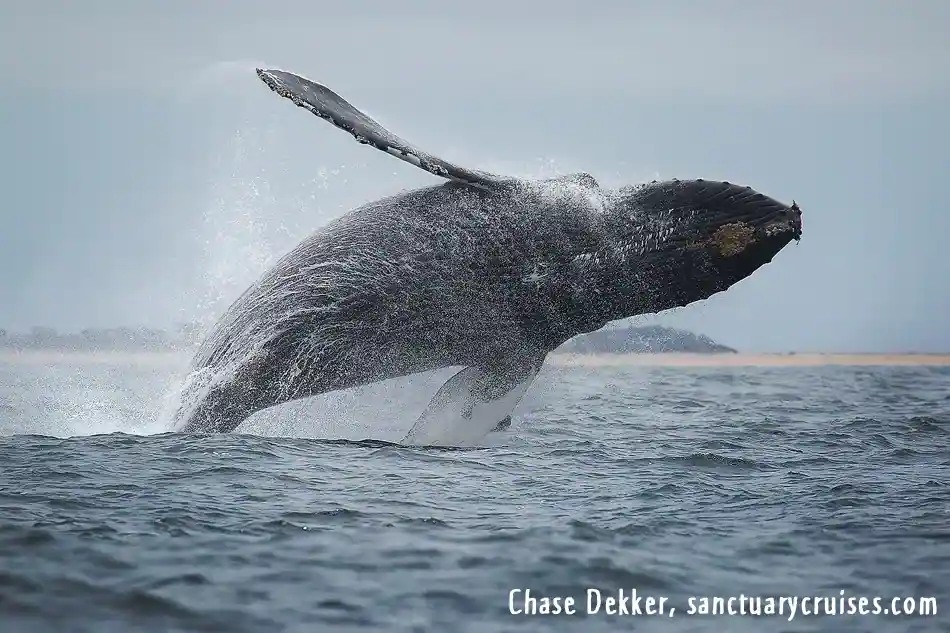
Whales of Monterey Bay
Four iconic species — humpback, blue, gray, and orca — share the waters of the Monterey Bay National Marine Sanctuary.
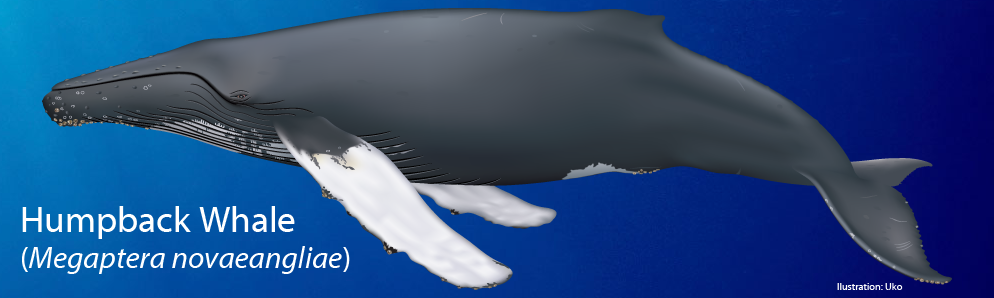
Humpback Whale
The acrobat of Monterey Bay. Adult humpbacks reach 52 feet and 40 tons, and we see them breaching, tail-slapping, and bubble-net feeding from spring through late fall. Our most consistent and reliable whale encounter.
- Scientific name: Megaptera novaeangliae
- Length: 40–50 ft (12–16 m) | Weight: up to 40 tons
- Lifespan: 80–90 years
- Diet: Krill, anchovies, herring — filter-fed using baleen plates
- Notable behaviour: Breach, tail-slap, pec-fin wave, bubble-net feeding in coordinated groups
- Conservation status: Least Concern (IUCN) — recovered from near-extinction after commercial whaling bans
Humpbacks are famous for their complex songs, produced only by males and lasting up to 20 minutes. On Monterey Bay they feed cooperatively using bubble nets — a rare and breathtaking behaviour to witness from the boat.
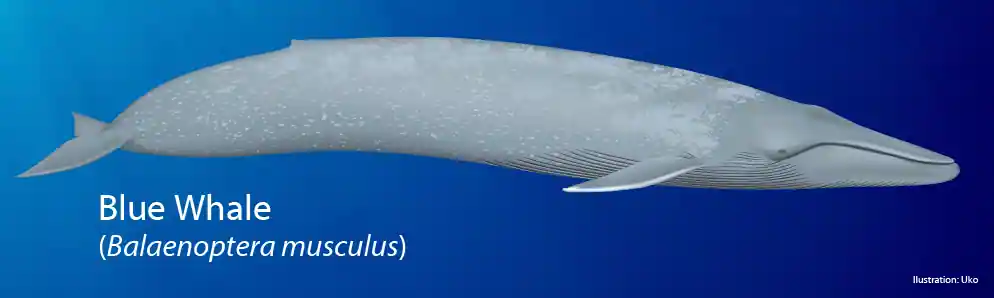
Blue Whale
The largest animal ever to have lived on Earth — up to 100 feet and 200 tons. Blues arrive in Monterey Bay in summer to feed on the dense krill aggregations that gather along the submarine canyon edge. Their misty, 30-foot blow is unmistakable.
- Scientific name: Balaenoptera musculus
- Length: up to 100 ft (30 m) | Weight: up to 200 tons
- Heart size: approximately the size of a small car
- Diet: Almost exclusively krill (Euphausia pacifica) — up to 4 tons per day
- Blow height: up to 30 ft (9 m) — visible for miles
- Conservation status: Endangered (IUCN)
Monterey Bay is one of the best places on Earth to see blue whales. The Monterey Submarine Canyon creates an upwelling that concentrates krill in vast patches near the surface — and the blues follow. On a good summer day we may see 10 or more in a single trip.
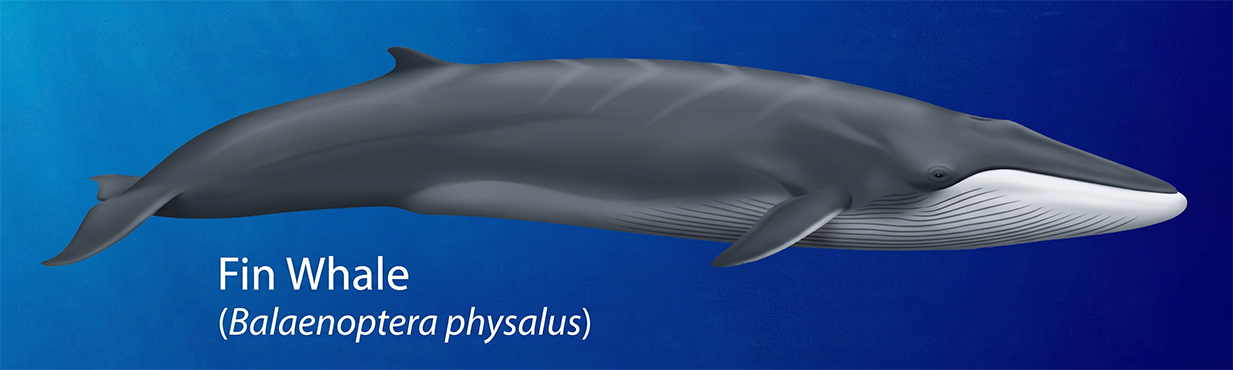
Fin Whale
Streamlined giants of the open ocean. The second-largest animal on Earth, fin whales pass through Monterey Bay year-round but are most reliably spotted in fall and winter when they congregate to feed on dense krill patches over the canyon.
- Scientific name: Balaenoptera physalus
- Length: 60–80 ft (18–24 m) | Weight: 40–80 tons
- Nicknames: "Greyhound of the sea" — among the fastest of all great whales
- Speed: Up to 23 mph (37 km/h)
- Diet: Krill, small schooling fish, squid
- Conservation status: Vulnerable (IUCN)
Fin whales are built for speed — their sleek, tapered bodies and powerful flukes allow them to lunge through bait balls at remarkable velocity. A distinctive asymmetrical coloration (white on the lower right jaw, dark on the left) makes them unique among all whales. When fin whales descend on Monterey Bay in numbers, it signals an exceptional krill bloom and often draws blue whales and humpbacks to the same feeding grounds.
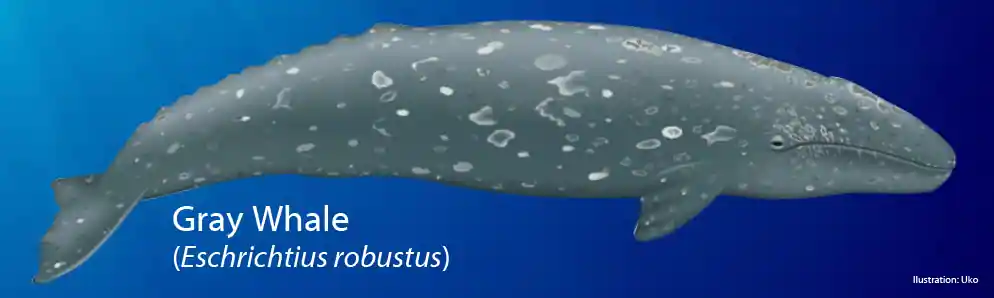
Gray Whale
Grays migrate past Monterey Bay twice a year — south to Baja California in winter, then north to the Arctic in spring with newborn calves. We often see mothers and calves travelling close to shore.
- Scientific name: Eschrichtius robustus
- Length: 40–50 ft (12–15 m) | Weight: 30–40 tons
- Migration: 10,000–12,000 miles each way — one of the longest of any mammal
- Diet: Bottom-feeding amphipods — unlike most baleen whales
- Identification: Mottled grey skin covered in barnacles and whale lice; no dorsal fin, just a series of knuckles
- Conservation status: Least Concern (Eastern North Pacific population)
Gray whales were hunted nearly to extinction twice. The Eastern North Pacific population made a full recovery after protections were enacted in the 1940s and 1960s. Calves are born at around 15 feet long in the warm lagoons of Baja California and must immediately begin the 5,000-mile journey north.
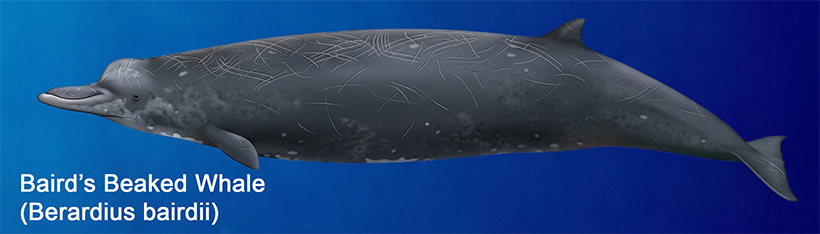
Baird's Beaked Whale
Mysterious giants of the deep. Baird's beaked whales are the largest of all beaked whales, surfacing briefly from extreme depths after dives that can last over an hour. Monterey Bay's underwater canyon makes it one of the best places in the world to encounter them.
- Scientific name: Berardius bairdii
- Length: 35–42 ft (10.7–12.8 m) | Weight: 10–12 tons
- Habitat: Deep offshore waters — typically over 3,000 ft (900 m) depth
- Dive depth: Over 3,000 ft (900 m) | Dive duration: 30–60+ minutes
- Diet: Deep-sea fish, squid, octopus, skates
- Conservation status: Least Concern (IUCN)
Baird's beaked whales travel in tight social groups of 3–10 individuals and are rarely seen at the surface — making every sighting a rare event. Their long, dolphin-like rostrum and heavily scarred skin (from social sparring) make them unmistakable up close. Summer months offer the best chance of an encounter over the Monterey Submarine Canyon.
Meet them in person
We see whales and/or dolphins on well over 95% of our trips.
Book a Whale Watching Cruise