
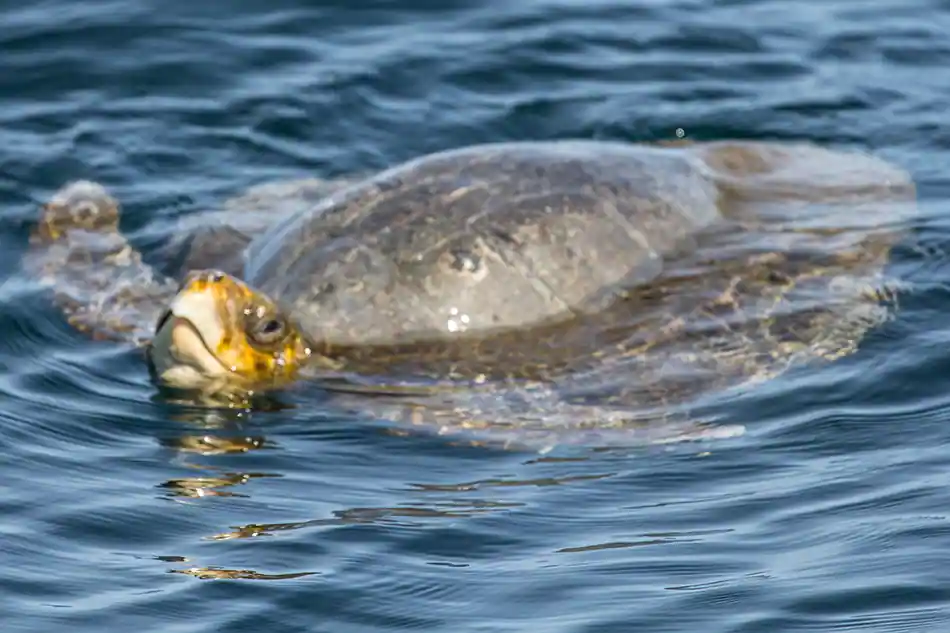
Other Marine Life
Sea turtles, sharks, rays, and the extraordinary ocean sunfish — the bay is home to some of the most remarkable marine life on the planet.
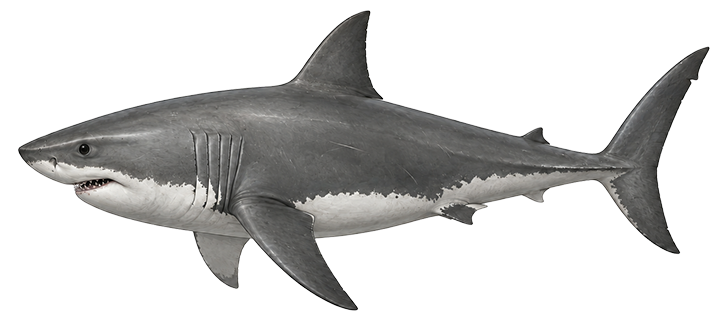
Great White Shark
The apex predator of Monterey Bay. Great whites gather here in summer and fall, drawn by the large pinniped population at Año Nuevo and the Farallon Islands. We run dedicated shark tours — surface encounters are possible and extraordinary.
- Scientific name: Carcharodon carcharias
- Length: Up to 20 ft (6 m) | Weight: Up to 5,000 lbs
- Teeth: Up to 300 serrated teeth in multiple rows; replaced continuously throughout life
- Speed: Up to 25 mph in short bursts; can breach completely clear of the water
- Senses: Detects one drop of blood in 25 gallons of water; can sense electromagnetic fields of prey
- Conservation status: Vulnerable (IUCN) — protected in California since 1994
Great White Sharks are highly migratory, moving seasonally between a central Pacific "Café" area in winter and coastal feeding grounds in summer and fall. Monterey Bay and the nearby Farallon Islands are key feeding sites, where sharks prey on elephant seals, sea lions, and harbor seals. Despite their fearsome reputation, great whites are curious rather than aggressive toward boats — surface encounters during our dedicated shark tours are memorable and safe.
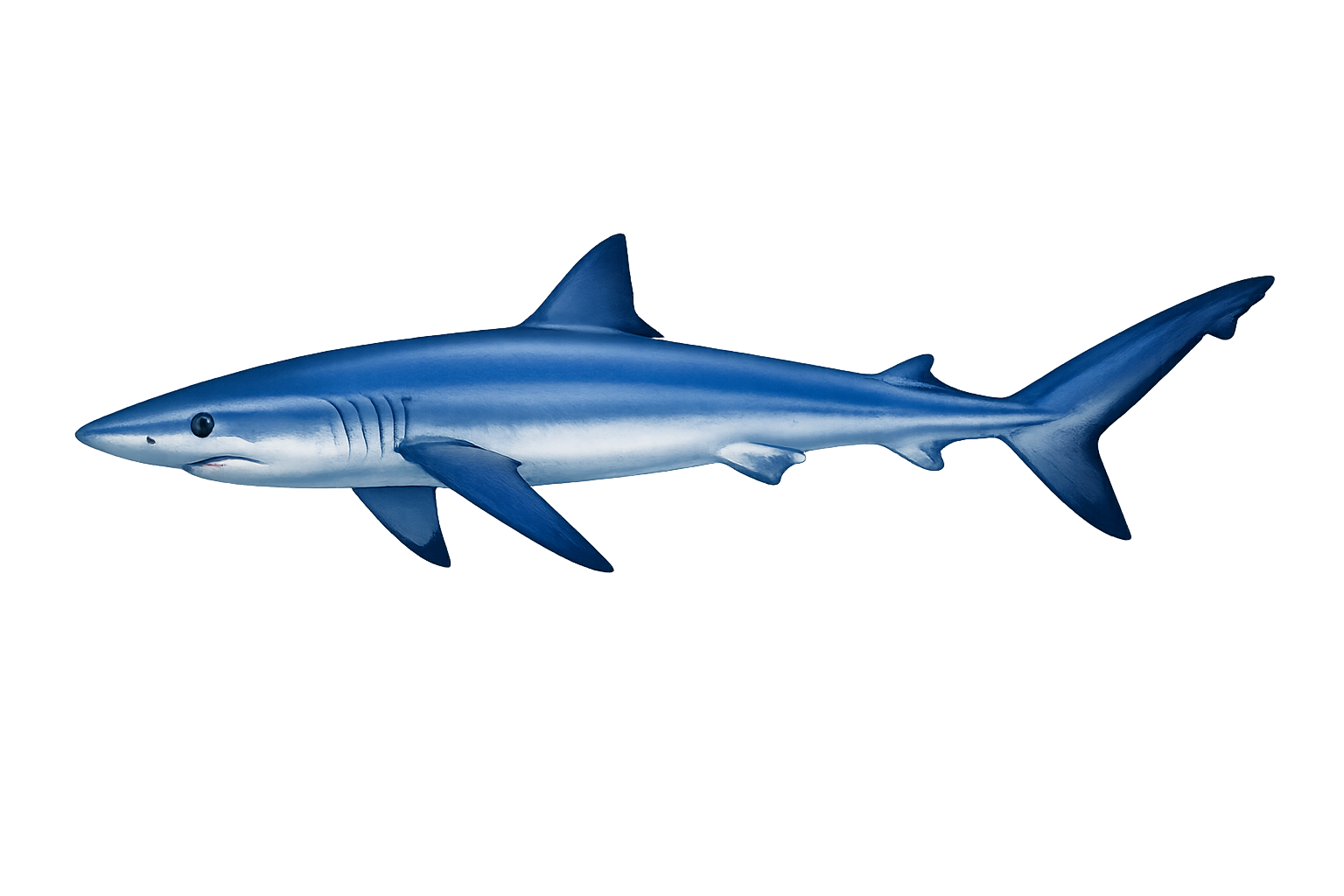
Blue Shark
Sleek, ocean-blue sharks that range far offshore. Blue sharks are often encountered on longer trips in summer — graceful swimmers that may circle the boat with genuine curiosity. Among the most beautiful sharks in the world.
- Scientific name: Prionace glauca
- Length: Up to 13 ft (4 m) | Weight: Up to 450 lbs
- Identification: Vivid indigo-blue on back and flanks fading to white below; long slender pectoral fins; large eyes
- Diet: Squid, small fish, crustaceans — often feeds near the surface at night
- Range: All temperate and tropical oceans; one of the most wide-ranging fish in the world
- Conservation status: Near Threatened (IUCN) — heavily targeted by longline fisheries as bycatch
Blue sharks are among the most abundant large sharks in the open ocean. They are highly migratory, circling the North Atlantic and Pacific in predictable gyres following prey. In Monterey Bay they appear in summer when the offshore water warms, often following the same squid concentrations that attract other predators. Their striking colouration fades rapidly after death — the vivid blue is only seen in living animals.
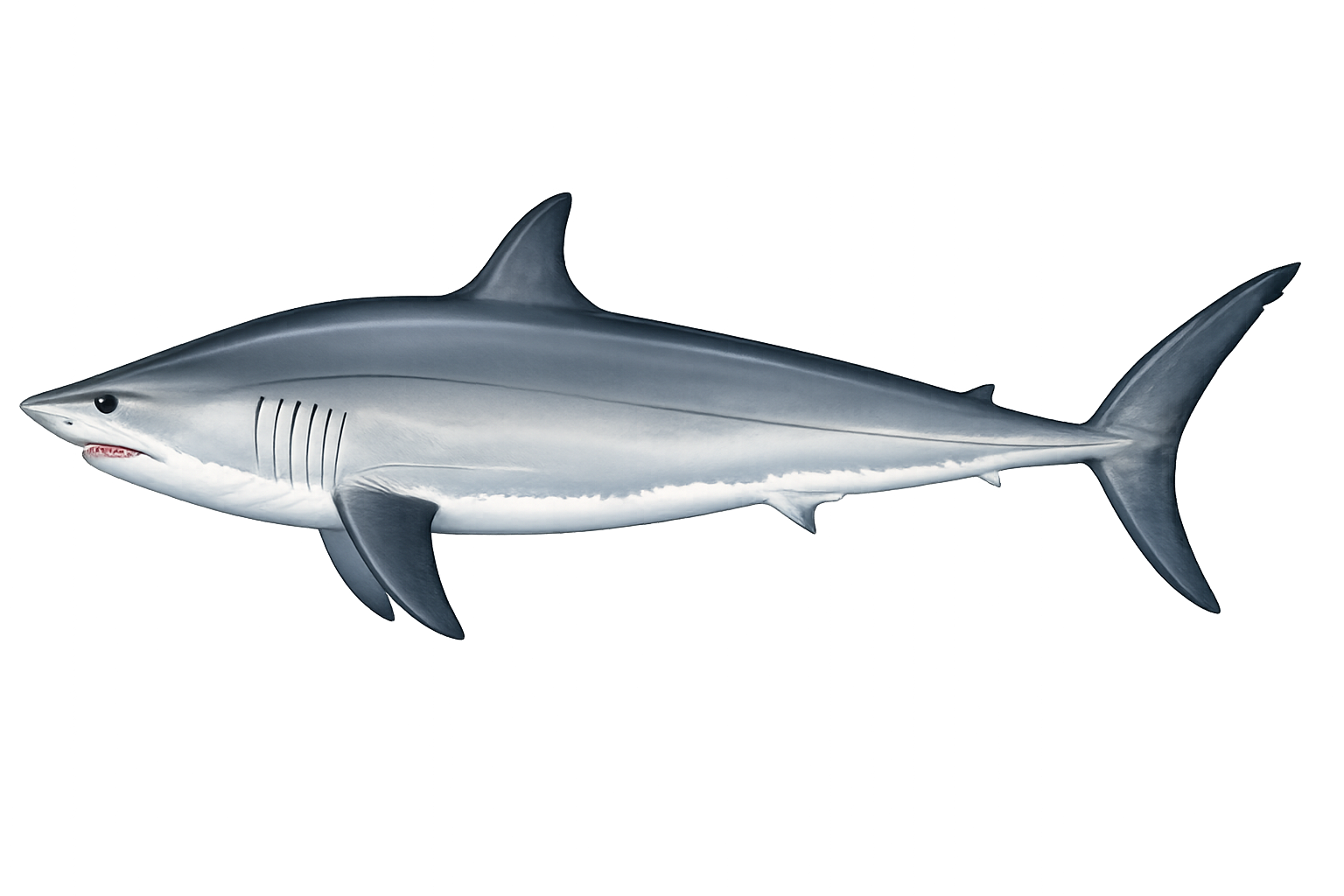
Shortfin Mako
The fastest shark in the ocean. Makos are occasionally encountered in the warmer months offshore — their speed and power is unmistakable. A rare but thrilling encounter.
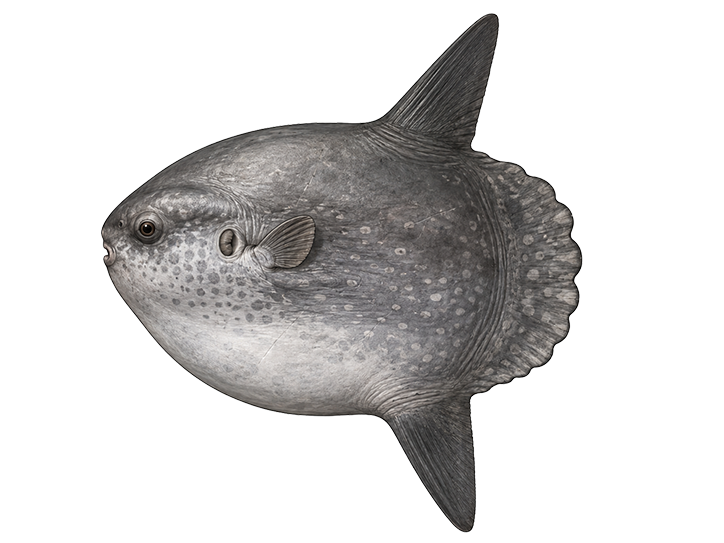
Mola Mola (Ocean Sunfish)
The world's heaviest bony fish — up to 5,000 lbs. Molas are bizarre, disc-shaped fish that bask at the surface in warm months, often lying on their sides. A truly alien-looking sight.
- Scientific name: Mola mola
- Weight: Up to 5,100 lbs (2,300 kg) — heaviest bony fish on Earth
- Length: Up to 11 ft (3.3 m) fin-to-fin
- Diet: Primarily jellyfish, salps, and soft-bodied invertebrates from deep water
- Behaviour: "Basking" at the surface (lying on side) thought to allow seabirds to pick off parasites; also thermoregulates after deep cold-water dives
- Conservation status: Vulnerable (IUCN) — frequently caught as bycatch
The ocean sunfish looks like a fish that forgot to grow a tail — the body ends abruptly in a rudder-like structure called a clavus. Despite their enormous size, molas are gentle filter-like feeders that spend much of their time in deep cold water chasing jellyfish and salps, then rising to the surface to warm up. Monterey Bay is one of the most reliable places in the world to see them, particularly in late summer when warm-water eddies push into the bay.
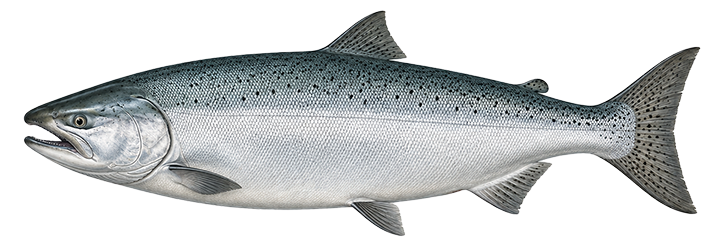
Pacific Salmon
Chinook and Coho salmon move through the bay on their way to and from spawning rivers. When salmon are running, bait balls form, bringing in a cascade of predators — from seabirds overhead to whales below.
- Species seen: Chinook (King) Salmon Oncorhynchus tshawytscha — largest; Coho (Silver) Salmon Oncorhynchus kisutch
- Chinook size: Up to 5 ft (1.5 m) and 130 lbs — the largest Pacific salmon
- Life cycle: Born in freshwater rivers, migrate to ocean for 2–5 years, return to exact birth river to spawn
- Navigation: Uses Earth's magnetic field and sense of smell to find their home river after years at sea
- Ecological role: Marine-derived nutrients carried into forests by spawning salmon feed bears, eagles, and forest trees
- Conservation status: Many Central California populations listed as Threatened or Endangered under ESA
Chinook salmon that feed in Monterey Bay are bound for the Sacramento River system, the Klamath, or Central Coast rivers. The California commercial salmon season has faced severe restrictions in recent years due to declining populations — making each salmon you see on the bay increasingly precious. When salmon schools are present, the feeding activity they trigger ripples through the entire food chain.
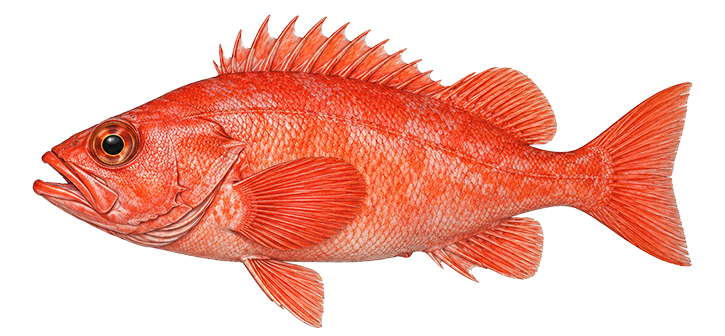
Rockfish
Over 60 species of colourful rockfish live around the canyon ledges and reefs of Monterey Bay. They are a foundational part of the food web — the prey that feeds seabirds, dolphins, and whales above them.
- Family: Sebastes — over 60 species in California waters, more than anywhere on Earth
- Common species in Monterey: Canary rockfish, blue rockfish, olive rockfish, widow rockfish, bocaccio
- Lifespan: Some species live over 200 years — among the longest-lived fish in the world
- Habitat: Rocky reefs, kelp forests, and deep canyon walls — from the intertidal zone to 3,000 ft depth
- Reproduction: Viviparous — give birth to live larvae rather than laying eggs
- Conservation status: Varies by species — several are overfished; others recovering under management
The Monterey Submarine Canyon supports extraordinary rockfish diversity. Some deep-dwelling species around the canyon walls may be over a century old. Rockfish are the primary prey for many of the animals you see from the boat — Brandt's Cormorants, Common Murres, Risso's Dolphins, and even humpback whales target rockfish aggregations at depth. Their recovery is closely tied to the health of the broader Monterey Bay ecosystem.
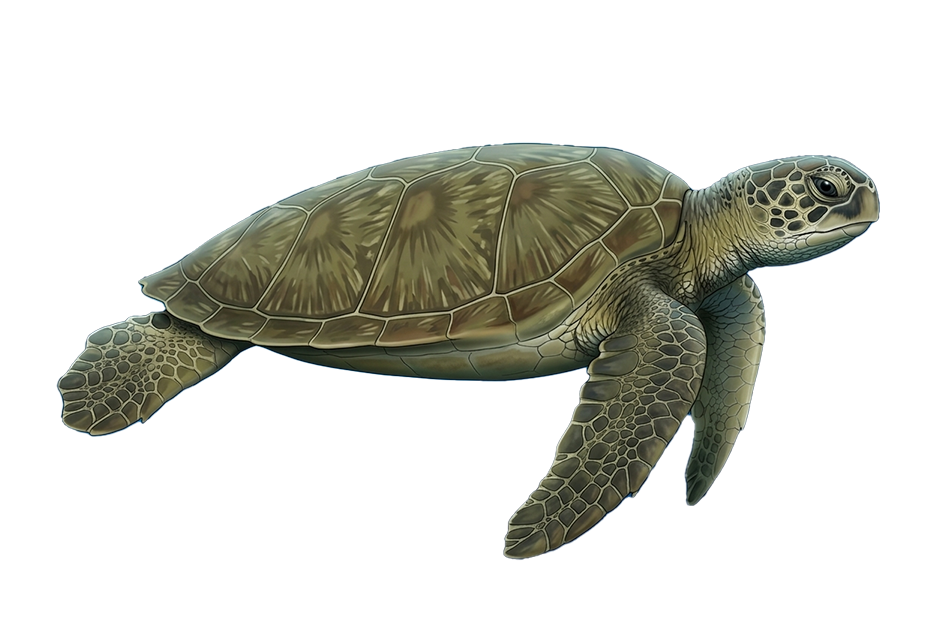
Green Sea Turtle
Ancient mariners of warm waters. Green sea turtles are occasional but unforgettable visitors to Monterey Bay, riding the warm El Niño currents that periodically push north along the California coast. A sighting is always a surprise — and always a highlight of the trip.
- Scientific name: Chelonia mydas
- Length: 3–4 ft (0.9–1.2 m) | Weight: 150–400 lbs
- Lifespan: 80+ years — one of the longest-lived marine animals
- Range: Tropical and subtropical oceans worldwide; warm-water strays reach Central California
- Diet: Seagrass, algae — adults are among the few herbivorous sea turtles
- Conservation status: Endangered (IUCN)
Named not for their shell but for the greenish color of their fat — a result of their plant-heavy diet — green sea turtles are one of the ocean's great navigators, returning to the same beaches where they were born to nest decades later. Sightings in Monterey Bay are most likely during warmer water years, when individuals stray far north of their typical range chasing food and favorable currents.
Discover more marine life
From sea turtles to sharks and the strange mola mola — every trip reveals something extraordinary.
Book a Cruise